If you have been wondering whether black and white worksheets are actually better for preschool learning than colorful ones, the answer might surprise you.
It is Sunday evening. You just found what looks like a perfect preschool activity pack online, colorful, illustrated, eye-catching. You hit print. Forty-five pages later, your printer is groaning and your color ink cartridge is flashing red. You check the replacement cost. You close the browser.
Sound familiar?
If you have been homeschooling or teaching preschool for any amount of time, you know this moment. And if you are newer to it, you are about to discover one of the most counterintuitive truths in early childhood education: the materials that look the most impressive to adults are often not the most effective for children.
Black and white worksheets — simple, clean, high-contrast, ink-saving — are not a budget compromise. They are, in most developmental contexts, the better choice. The research supports it. Experienced educators know it. And once you understand why, you will never look at a heavily pre-colored activity sheet the same way again.
This guide covers the developmental science behind why black and white worksheets work, the practical benefits for families and classrooms, how to use them most effectively, and what to look for when choosing printable resources that are genuinely worth printing.
The Problem With Pretty: Why Colorful Worksheets Often Work Against Young Learners {#problem-with-pretty}
Here is the thing about highly colored, pre-illustrated worksheets: they are designed to appeal to adults. The bright colors, the detailed characters, the cheerful backgrounds — these are the features that make a parent or teacher click “add to cart.” They signal effort, quality, care.
But young children are not adults, and their brains process visual information very differently.
When a preschooler sits down with a heavily pre-colored worksheet, their visual attention is pulled in multiple directions simultaneously. The bright background competes with the letter they are supposed to trace. The colorful character in the corner is more interesting than the number they are supposed to count. The decorative border uses up processing bandwidth that the child’s brain needs to focus on the actual learning task.
This is not speculation. It is the result of well-documented research on cognitive load and visual processing in young children — and understanding it changes how you think about the materials you put in front of learners.
What Cognitive Load Theory Tells Us
Cognitive Load Theory, developed by educational psychologist John Sweller in the 1980s and extensively validated since, describes the limits of working memory and what happens when those limits are exceeded. Working memory — the system that holds and processes information in the moment — is finite. When it is overwhelmed by competing stimuli, learning slows down or stops.
For young children, whose working memory is still developing and significantly smaller than an adult’s, this limitation is especially pronounced. A heavily decorated worksheet that an adult perceives as engaging and organized can genuinely overwhelm a four-year-old’s processing capacity.
A clean, high-contrast black and white design reduces the extraneous cognitive load — the mental effort spent on things that are not the learning task — and frees up working memory for the germane cognitive load, the actual thinking and learning the activity is designed to produce.
In plain language: when there is less visual noise, children can think more clearly about what they are supposed to be learning.
The Developmental Science Behind Black and White Design {#developmental-science}
The case for black and white worksheets is not just about cognitive load. There are several other developmental factors that point in the same direction.
How Young Children’s Vision Develops
Infant vision researchers have known for decades that young children respond most strongly to high-contrast images — black and white patterns, bold outlines, sharp edges. This is because the contrast-processing pathways in the visual cortex develop before the color-processing pathways.
By preschool age, color vision is fully developed, but the preference for high-contrast, clearly defined shapes and outlines persists as a processing advantage. When the lines on a worksheet are bold and the background is clean white, the child’s visual system can lock onto the relevant shapes — letters, numbers, path lines — faster and with less effort.
This is why well-designed black and white worksheets almost always feature bold, thick outlines and generous white space. The boldness of the line is a design decision with a developmental rationale behind it.
The Role of Contrast in Early Literacy
For children who are learning to read and write, visual contrast is especially important. Letter recognition depends on the ability to discriminate between similar shapes — to see that “b” and “d” are different, that “m” and “n” are different, that “p” and “q” are mirror images of each other. These discriminations are easier to make when the letters are presented in high contrast against a clean background.
When a letter is printed over a colorful illustrated background — a trend common in highly decorated activity sheets — the contrast between the letter and its background is reduced. This makes the letter harder to see, harder to focus on, and harder to learn from.
Black letter on white page is the highest-contrast format available. It is also, not coincidentally, the format in which children will encounter printed text for the rest of their lives. Teaching children to read and write using the actual format of real text is not a limitation — it is an alignment.
Visual Attention and the Learning Brain {#visual-attention}
One of the most important — and most underappreciated — aspects of effective worksheet design is where it directs the child’s visual attention.
The Attention Direction Principle
Every element on a page competes for a child’s attention. Good educational design uses visual hierarchy to direct attention deliberately: the most important element — the letter, the number, the path — is the most visually prominent element. Everything else on the page is subordinate to it.
In a well-designed black and white worksheet, this hierarchy is achieved through bold outlines, generous white space, and the strategic absence of competing visual elements. The child’s eye goes naturally to the letter because the letter is what stands out.
In a heavily pre-colored worksheet, visual hierarchy is often inverted. The decorative elements — the characters, the backgrounds, the borders — are sometimes more visually prominent than the learning content. A child who spends more time looking at the cartoon animals in the margins than at the letters they are supposed to trace is not being distracted. Their brain is responding rationally to the visual signals the page is sending.
Eye-Tracking Research in Educational Materials
Studies using eye-tracking technology with young learners have shown consistently that children spend significantly more time looking at illustrative and decorative elements than at instructional content when those elements are present on the same page. This finding has been replicated across multiple research contexts and is one of the foundational principles of educational material design.
The implication is clear: if you want a child to look at a letter, put the letter on a clean page where it is the most interesting thing on the page — not one element competing for attention among many.
The Ownership Effect: Why Children Learn More From What They Color Themselves {#ownership-effect}
Here is one of the most practically powerful arguments for black and white worksheets, and it comes not from cognitive science but from motivational psychology.
What the Research on Ownership Tells Us
Research on intrinsic motivation in young children consistently shows that children are more engaged with, more invested in, and more likely to remember activities in which they have made meaningful choices. Psychologists call this the “endowment effect” in the context of possessions — we value things more when we feel we own them — and it extends to learning activities as well.
When a child colors in a black and white worksheet, they are making hundreds of small decisions: this letter will be blue, this animal will be green, this number will be red. These choices are not trivial. They are the child’s creative signature on the work. The worksheet becomes theirs in a way that a pre-colored activity sheet never can be.
This sense of ownership does several important things. It increases engagement during the activity — children who are invested in how something looks pay more attention to the details. It increases the emotional significance of the completed work — a child who colored that worksheet is proud of it in a way that has nothing to do with the content and everything to do with the authorship. And it increases the likelihood that the child will talk about the work, share it, display it — all of which create additional opportunities for the learning content to be revisited and reinforced.
The Pride-in-Work Effect
Ask any experienced preschool teacher which worksheets children take home most eagerly: the ones that arrived in full color from the printer, or the ones they colored themselves. The answer is always the same. Children want to show their families what they made — and “I colored this myself” is a different kind of pride than “the printer did this, and I traced the letter.”
That pride is not a small thing. It is motivational fuel. A child who feels proud of their work is a child who wants to do more work. Over the course of a school year, that motivation compounds dramatically.
Fine Motor Development and Printable Activities {#fine-motor}
Black and white worksheets are not just about letter recognition and number practice. They are also one of the most accessible and effective tools for fine motor development — a developmental domain that is essential for kindergarten readiness and often underemphasized.
Why Fine Motor Skills Matter
Fine motor skills — the small muscle movements of the hands and fingers — are required for writing, cutting, buttoning, zipping, and dozens of other daily tasks. Children who arrive at kindergarten with underdeveloped fine motor skills often struggle with writing not because they do not know their letters but because their hands are not yet strong enough or coordinated enough to form them legibly.
The window for building fine motor strength is wide open during the preschool years, and printable activities are among the most effective tools we have for developing it.
What Different Types of Printable Activities Build
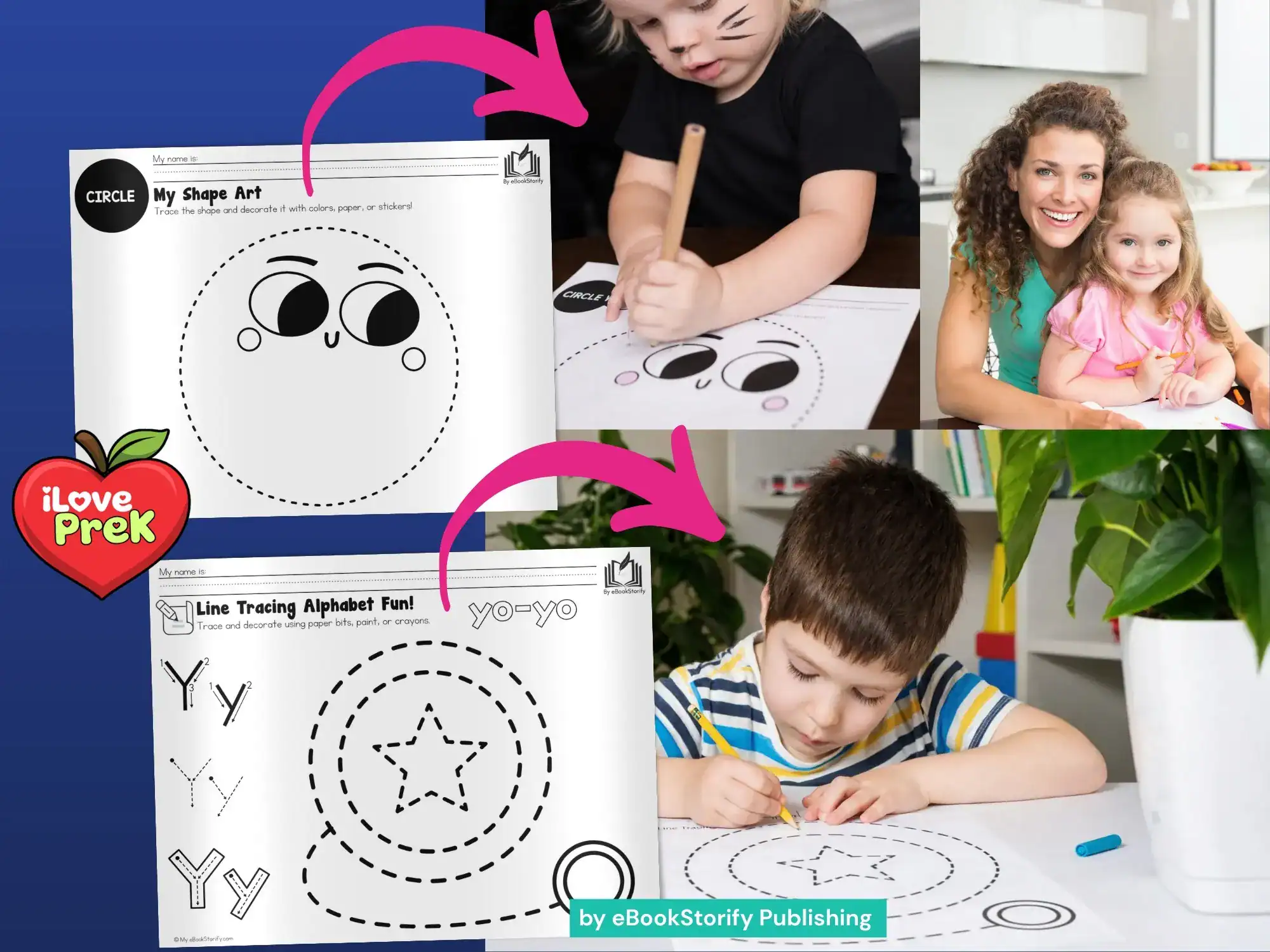
Tracing activities — following dotted lines, tracing letter shapes, completing patterns — build the precise, controlled hand movements needed for handwriting. The resistance of pencil on paper develops grip strength and control simultaneously.
Coloring activities — staying within lines, applying consistent pressure, covering large areas with small strokes — build the sustained hand control and fine motor endurance needed for extended writing tasks.
Cutting activities — using child scissors to follow lines, cut shapes, create collages — develop the bilateral coordination (both hands working together) that underlies many fine motor tasks.
Dot marker activities — pressing a large foam marker onto specific spots on the page — develop the visual-motor integration that connects what the eye sees to what the hand does, a skill that is foundational for both writing and reading.
Maze activities — navigating a path through a maze with a pencil or crayon — develop planning, directionality, and the kind of sustained visual attention that supports both literacy and math.
Our Complete Preschool Curriculum includes all of these fine motor activity types woven throughout every week of the year — tracing, coloring, cutting, dot marker work, and 40 progressive mazes — all in clean black and white format that children can personalize and that parents and teachers can afford to print generously.
Screen Time vs. Printables: What the Research Actually Says {#screen-vs-print}
One of the most common conversations in early childhood education right now is about the role of screens in young children’s learning. Educational apps and interactive digital activities are everywhere, and many of them are genuinely impressive. So why choose printables?
What the American Academy of Pediatrics Says
The American Academy of Pediatrics (AAP) recommends that children between ages two and five have no more than one hour of high-quality screen time per day, and that screen time should generally not replace physical play, hands-on activities, or face-to-face interaction.
The rationale is developmental: young children learn most effectively through physical interaction with the world — touching, manipulating, drawing, building, moving — and through rich verbal interaction with caring adults. Screen-based activities, even high-quality ones, provide neither of these things.
The Transfer Problem
Research on early learning consistently identifies what is called the “video deficit effect” — the finding that very young children learn significantly less from screen-based demonstrations than from identical demonstrations delivered in person or through hands-on experience. Even older preschoolers show reduced transfer of learning from screen to real-world application compared to children who learned through hands-on materials.
What this means in practice: a child who practices letter tracing on a tablet touchscreen may not transfer that skill to pencil-on-paper as effectively as a child who practiced with a physical pencil and a printed worksheet. The motor memory built through physical interaction with real paper and real writing tools is different from — and more directly applicable to — the real writing tasks children will encounter in kindergarten and beyond.
Printables as a Screen-Free Alternative
Black and white printable worksheets are inherently screen-free. They do not require a device, a battery, a WiFi connection, or a subscription. They can be done anywhere — at the kitchen table, in the car, at grandma’s house, on the floor of a waiting room. They do not emit light at the child’s eyes. They do not auto-advance or provide instant reward animations that can become habit-forming.
And they produce something real: a physical artifact the child created with their own hands, that they can hold, display, take home, and show their family. That tangibility matters more than most adults realize to young children, for whom the physical world is still more real and meaningful than the digital one.
The Real Cost of Color Printing — and What You Could Do With That Money Instead {#real-cost}
Let us talk numbers, because this is where the practical case for black and white printables becomes very concrete very quickly.
What Color Printing Actually Costs
The average cost of printing a color page on a standard home inkjet printer is estimated at between 5 and 20 cents per page, depending on the printer model, ink type, and coverage percentage. At the lower end of that range — 5 cents per color page — a 200-page color curriculum pack costs $10 in ink alone, on top of the purchase price of the digital file.
At the higher end — 20 cents per color page — that same pack costs $40 in ink. And if you have multiple children, or you are a teacher printing for a classroom, you multiply those costs accordingly.
A typical preschool year, if you are using color-heavy materials throughout, can easily cost $150 to $300 in ink alone. That is a significant expense for something that ends up recycled at the end of the year.
What Black and White Printing Costs
The average cost of printing a black and white page on the same home printer is between 1 and 3 cents per page. A 200-page black and white curriculum pack costs $2 to $6 in ink. A full preschool year of black and white materials, printed generously, costs $25 to $50 in ink.
That is a saving of $100 to $250 per year — money that could go toward hands-on materials, manipulatives, field trips, books, or simply back into the family budget.
The “Print as Many Times as You Need” Advantage
One of the most underappreciated advantages of black and white printable resources is that they are infinitely reprinkable at a cost that makes reprinting practical. When a child needs to repeat a tracing activity, when a younger sibling is ready to start the curriculum, when a teacher wants to send a worksheet home for practice — you print again. At 1 to 3 cents a page, that decision is effortless.
With color materials, every reprint is a meaningful cost. This creates a subtle but real reluctance to use materials generously, to let children repeat activities, or to share resources with families. Black and white removes that reluctance completely.
Our entire iLovePreK printable library is designed in black and white for exactly this reason: so that you can print what you need, when you need it, as many times as you need it, without watching your ink budget and wondering if this activity is worth it.
How to Choose High-Quality Black and White Printables {#how-to-choose}
Not all black and white worksheets are equal. Here is what to look for when evaluating printable resources for young learners.
Bold, Clear Lines
The outlines of letters, numbers, shapes, and paths should be thick and bold enough to be visible and easy to follow at small scale. Thin, faint lines are difficult for young children to see clearly and even harder for small hands to trace accurately. Look for worksheets where the visual elements are drawn with confidence and weight.
Generous White Space
A good worksheet is not crowded. There should be enough space for a child to work — to color, to trace, to draw — without feeling cramped. White space is not wasted space. It is the breathing room that allows the learning content to be the focus.
Clear, Simple Instructions
Every activity should include a simple, explicit instruction — not just a visual prompt that assumes the child knows what to do. Even for activities that seem visually self-explanatory, a brief written instruction ensures that educators and caregivers can orient the child to the task quickly and consistently.
Developmentally Calibrated Difficulty
A tracing path that is appropriate for a two-year-old is too simple for a five-year-old. Look for resources that are clearly designed for a specific age range and that offer progressive challenge within that range. Activities that are too easy produce boredom; activities that are too hard produce frustration. The sweet spot is the activity that requires genuine effort but is achievable with that effort.
Variety Within Consistency
The best printable curriculum packs maintain a consistent visual style and format — so children know what to expect and can focus on the content rather than figuring out the format — while offering enough variety in activity type to stay engaging across a full school year. Tracing, writing, coloring, cutting, matching, sorting, dot marking, mazes — a well-rounded curriculum uses all of these and rotates through them regularly.
The Animal Alphabet Workbook for PreK and Kindergarten and the Toddler Alphabet Workbook are both designed with these principles in mind: bold lines, clean layout, clear instructions, and a variety of activity types within a consistent visual style. The Busy Book Cut and Match Activities adds the cutting and matching dimension — both critical fine motor skills — in a format that stays engaging across multiple sessions.
Organizing Your Printables for a Full School Year {#organizing}
Having great printable resources is one thing. Having them organized so that you can actually find and use them efficiently is another. Here is a simple system that works for both homeschool families and classroom teachers.
The Monthly Binder System
Print one month’s worth of materials at a time and organize them into a labeled binder with tabbed sections: Week 1, Week 2, Week 3, Week 4. Each week’s section contains everything needed for that week — lesson plan, worksheets, craft instructions, any additional materials. On Sunday evening, pull out the Week 1 section and you are ready for Monday.
This system has two major advantages. First, it makes Monday morning completely frictionless — everything is pre-sorted and ready. Second, it prevents the common trap of printing everything at once and then feeling overwhelmed by a stack of 200 pages with no clear order.
The “Print When You Need It” Approach
An alternative to batch printing is maintaining the digital files organized by week or by skill and printing only what you need for the coming week. This approach uses less storage space — no physical binders — and allows you to be more responsive to what is working and what is not. If a child needs to repeat a particular activity, reprint it. If a particular activity is not clicking, skip it and come back later.
Color Coding Without Color Ink
You can create a visual organization system for black and white printables without using color ink. Use different colored file folders for different months or skill areas. Use colored sticky notes to mark key pages. Use a colored pen to write the week number or skill name on the top corner of each sheet before filing. All of these options let you create visual organization without printing a single drop of color ink.
What Great B&W Worksheets Look Like Across Different Skill Areas {#skill-areas}
Black and white worksheet design looks slightly different depending on the skill area, and understanding these differences helps you evaluate the quality of specific resources.
Literacy Worksheets
For letter recognition and early writing, look for worksheets that feature a single large letter prominently positioned, a clear tracing guide with directional arrows showing stroke sequence, a beginning-sound picture that is simple and recognizable, and space for independent practice after the guided tracing.
The best literacy worksheets also include a writing line — not just a box — because children need to learn the spatial conventions of writing on a line from the beginning. A worksheet that has children write letters in an open box is missing an opportunity to build this foundational skill.
Math Worksheets
For number recognition and early math, look for worksheets that connect numerals to quantities clearly, use ten-frame formats to build number sense visually, include a variety of representations — numerals, words, groups of objects — and progress logically from simple recognition to more complex tasks like ordering, comparing, and basic operations.
Fine Motor Worksheets
For fine motor development specifically, look for tracing paths that vary in width and complexity, cutting guides that progress from straight lines to curves to angles, dot-to-dot activities with clearly numbered dots, and directed drawing activities with step-by-step visual instructions.
Our Shape Lacing Cards, Number Lacing Cards, and Alphabet Lacing Cards extend fine motor practice beyond the page — threading a lace develops different muscles and coordination patterns than pencil-and-paper work, making these a powerful complement to printed worksheet activities.
Science and Social Studies Worksheets
For content-area learning at the preschool level, the best worksheets connect directly to a theme or topic the class is studying, use simple sorting and categorizing activities that build scientific thinking, and include a strong visual component — clear, labeled illustrations — that builds vocabulary alongside concept knowledge.
Common Questions About Printable Worksheets in Early Childhood {#common-questions}
Are worksheets appropriate for toddlers?
For very young toddlers — under two and a half — printable worksheets are generally not developmentally appropriate as a primary learning tool. At this age, sensory play, movement, and language-rich interaction are the most powerful learning vehicles. From about age two and a half onward, simple printable activities — large coloring pages, simple dot marker activities, basic shape tracing — can be introduced in short sessions as one part of a varied learning day.
How long should a worksheet session be?
As a general guideline, preschoolers between three and four years old can sustain focused worksheet work for about five to ten minutes per session. Children between four and five years old can typically manage ten to fifteen minutes. Beyond these windows, the quality of engagement tends to drop and the activity becomes counterproductive. Short, focused, and finished is better than long, dragging, and incomplete.
Should I correct my child’s worksheet work?
Correction at the preschool stage should be gentle, specific, and limited. Commenting on what is good — “I love how you stayed on the line here” — before offering a specific, actionable suggestion — “Let’s try this letter again; remember it starts at the top” — is far more effective than general corrections. The goal at this stage is building confidence and the habit of careful attention, not achieving perfect letter formation.
Can worksheets replace play?
No. Worksheets are one tool in a rich early childhood program, not the program itself. Children between three and six years old need daily physical play, imaginative play, social play, outdoor time, creative arts, music, movement, and rich verbal interaction. Worksheets work best when they are a contained, purposeful element within a day that includes all of these other forms of learning.
Building a Print-Ready Learning System That Works All Year {#building-system}
The most effective use of black and white printables is as part of a coherent, organized system — not a collection of individual activities downloaded from different sources and used without a plan.
A coherent system means that the skills introduced in one worksheet are revisited and built upon in later worksheets. That the activity types vary across the week. That the child experiences a clear sense of progression — each week adding to what came before. That the educator has a clear picture of where each child is and where they are heading.
Building that system from scratch takes hundreds of hours of planning, sequencing, and design. Most teachers and homeschool parents do not have those hundreds of hours. They have Sunday evenings and morning coffee before the children wake up.
The iLovePreK Complete Preschool Curriculum is that system, already built. Thirty-eight weeks of coherent, sequenced, skill-building instruction across literacy, math, science, social-emotional learning, and creative arts — all in clean, bold, ink-saving black and white. Over 2,400 pages. Organized by month and by week. Editable lesson plans in Google Docs format. A built-in spiral review system so no skill is introduced and abandoned. Lifetime updates included.
For families and classrooms that want a complete system without starting from scratch, browse the full curriculum collection at iloveprek.com/complete-curriculum/.
For families who prefer to build gradually, starting with individual skill packs, the Alphabet Workbooks, Fine Motor resources, and Assessment tools are all available individually, all in the same clean black and white format, all designed to work together as your collection grows.
Because the best learning system is the one you will actually use — consistently, generously, and without watching the ink level anxiously every time you hit print.
Explore more on the iLovePreK blog:
One Response